



EHS Compliance Management with Multiple RFCs and Legal Entities
It is common for different legal entities to coexist in the same facility: manufacturing, logistics, services. And it is one of the most frequent questions when speaking with industrial groups in Mexico: how to organize compliance when there are multiple RFCs on the same site, or multiple plants under different legal entities.
The principle: responsibility breaks down by physical location and tax entity
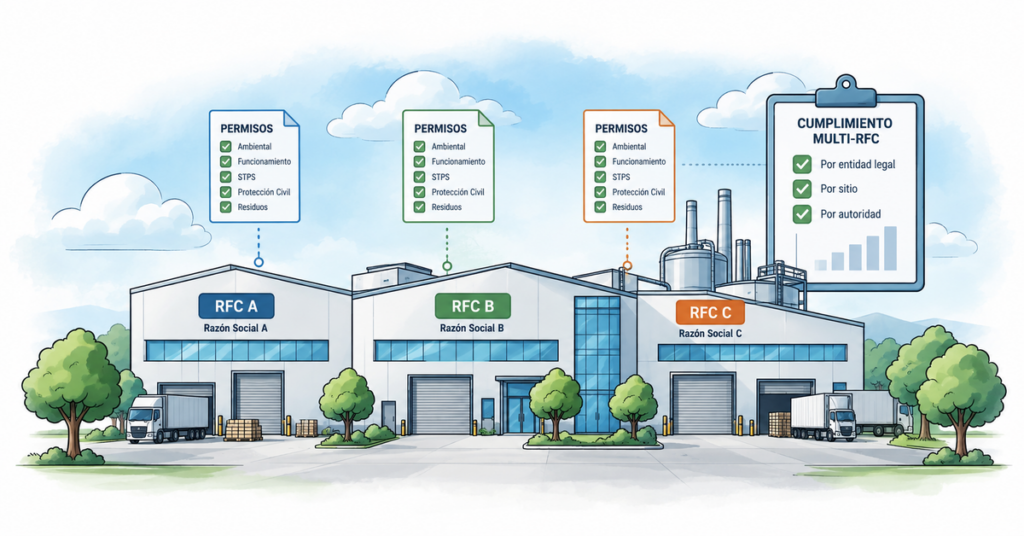
For authorities such as STPS, SEMARNAT, or Civil Protection, legal responsibility runs along two axes simultaneously. Most permits and registrations are issued to a combination of legal entity and facility: the operating license, hazardous waste generator registration, environmental permits, and employer registration are issued to a specific RFC for a specific address. A permit in the name of legal entity A does not cover the activities of legal entity B, even if they share the same roof. In an inspection, the authority reviews against the corresponding RFC.
The three most common scenarios
Group with multiple plants, each under its own legal entity: the challenge is visibility. Each entity has its own file, its expiration dates, and its responsible parties, and management needs the consolidated overview without losing the detail by entity.
Plant or site shared among legal entities of the same group: the challenge is delineation. Which obligation corresponds to whom, which evidence belongs to which file, and how to document what is shared, such as the property's PIPC versus the labor obligations of each employer.
Operation under shelter: a foreign company manufactures in Mexico under the legal entity and permits of a shelter company. Clarity about what the shelter fulfills and what corresponds to the client is the foundation of the relationship, and documentary traceability is what sustains it.
The traceability matrix: three views of the same information
What works in practice is to structure compliance in three layers. By legal entity, with the complete inventory of permits, registrations, and obligations for each RFC. By site, with the instruments specific to each property. And by authority, with the cross-sectional view of everything owed to STPS, SEMARNAT, or the municipality, to prepare inspections and corporate audits.
A centralized traceability matrix prevents duplication of procedures and avoids omissions in renewing environmental licenses and waste generator registrations by RFC. In spreadsheets, keeping those three views consistent is a full-time job that degrades with each change. Complex corporate structure is not a compliance problem: it is an information organization problem. Once that is resolved, compliance flows.
Controlling multiple RFCs and plants with independent dashboards and executive consolidation is the difference between a corporate audit that flows and one that is assembled by hand each quarter.
Sources consulted
- Operational article based on the general principle that federal, state, and municipal permits and registrations are issued by legal entity and facility.
- General Law of Ecological Balance and Environmental Protection (LGEEPA) — Chamber of Deputies
- Federal Labor Law (LFT) — Chamber of Deputies
- General Law for the Prevention and Comprehensive Management of Waste (LGPGIR) — Chamber of Deputies
- Municipal operating license regulations (consult according to the corresponding municipality).
Everything About EHS Software for Mexico


Take your compliance to the next level