



The STPS Inspection Has Arrived: Comprehensive Verification Guide for Manufacturing Plants
The inspector arrives at the front desk, identifies themselves, hands over the inspection order, and the clock starts running. What happens in the following hours depends on the level of prior documentary preparation of the operation, not on what gets improvised that day.
Legal framework and types of visits
Under article 540 of the Federal Labor Law and the General Regulation on Labor Inspection and Application of Sanctions, whose reform was published in the DOF on August 23, 2022, federal and state labor authorities carry out oversight under three modalities.
- Ordinary: scheduled according to the authority's annual programs, based on the activity and history of the workplace.
- Extraordinary: arising from complaints, serious accidents, or suspected violations. These can be carried out at any time.
- Guidance and advisory: free preventive visits that any company can request, which do not involve a sanctioning procedure. A tool that almost no one takes advantage of.
Required documentation in health and safety
The scope depends on the type of inspection and the line of business, but the typical checklist at a manufacturing plant includes:
- Updated and signed Health and Safety Program (NOM-030-STPS-2009)
- Labor competency certificates, DC-3 forms (NOM-019-STPS-2011)
- Risk analysis by position and by work area
- Records of personal protective equipment issuance signed by the worker (NOM-017-STPS-2024)
- Emergency response plan, evacuation routes, and drill records (NOM-002-STPS-2010)
- Minutes of the Health and Safety Commission and its walkthroughs
- Valid operating licenses and permits according to the line of business
The detail that makes the difference: it's not enough for the documents to exist. They must be current, signed, and available at the time of the visit. A drill without a documented attendance list, for inspection purposes, was not carried out.
Sanction deadlines and fines
The 2022 reform set deadlines that every EHS manager should keep in mind. The company has 5 business days after the closing of the record to present evidence that refutes the observations. For various matters, the regulation sets a generic correction period of 5 business days with no extension. The authority has 10 business days to issue the summons once the sanctioning procedure has begun. And after notification of a safety-related sanction, the authority will return within the following 60 business days to verify that the corrections have been implemented.
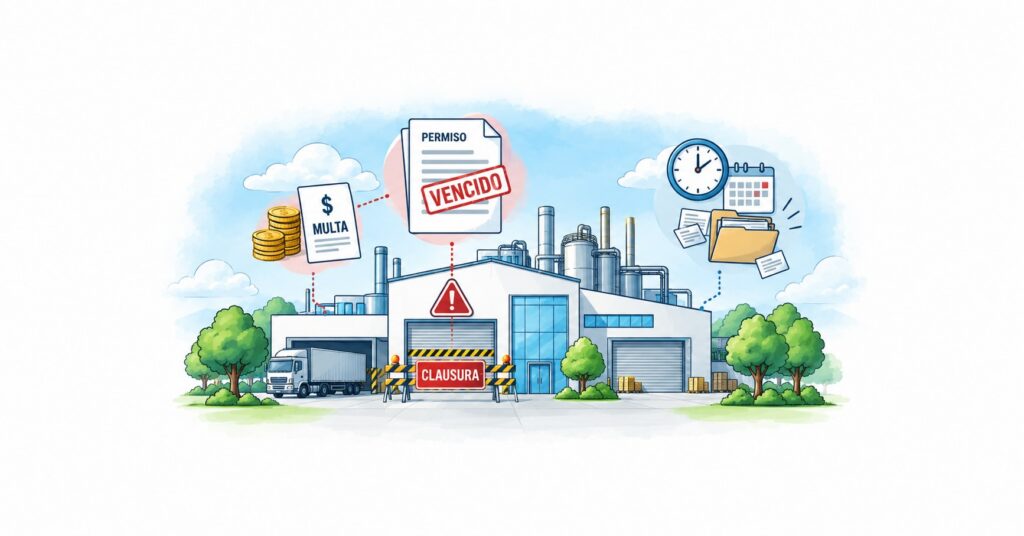
Financially, article 994 of the LFT provides for fines of 250 to 5,000 UMAs for non-compliance in health and safety, for each infraction detected. And in cases of imminent danger to workers, the authority can order immediate measures: restricting access or limiting operations in the risk areas. For a production line, that means a shutdown.
Real preparation doesn't begin when the inspector arrives
The difference between an inspection that flows smoothly and one that escalates lies in whether the team can answer three questions in minutes. Where each document is located and who is responsible for keeping it up to date. Which permits are valid and which require action today. And whether compliance can be demonstrated with organized evidence or depends on one person's memory.
Centralizing files, validity periods, and expiration alerts is what makes it possible to respond to an inspection in minutes instead of days.
Sources consulted
- General Regulation on Labor Inspection and Application of Sanctions (DOF reform 08/23/2022):
https://www.dof.gob.mx/nota_detalle.php?codigo=5662150&fecha=23/08/2022
- Full RGITAS text (Chamber of Deputies):
https://www.diputados.gob.mx/LeyesBiblio/regla/n395.pdf
- Federal Labor Law, arts. 540 and 994:
https://www.diputados.gob.mx/LeyesBiblio/pdf/LFT.pdf
- STPS, press release on the General Labor Inspection Regulation:
https://www.gob.mx/stps/prensa/el-nuevo-reglamento-de-inspeccion-del-trabajo-incentivara-la-productividad-stps
- NOM-030-STPS-2009, NOM-019-STPS-2011, NOM-017-STPS-2024, NOM-002-STPS-2010 (DOF, available at
www.dof.gob.mx)
Everything About EHS Software for Mexico

Take your compliance to the next level