



Environmental Impact Assessment in Mexico: EIA and SEMARNAT Process
Any industrial project in Mexico that may affect the environment requires authorization from SEMARNAT through an Environmental Impact Statement. This is not a routine procedure. It is a legal requirement under the General Law of Ecological Balance and Environmental Protection (LGEEPA), and operating without it when required can result in facility closure, fines, and criminal liability.
The EIA process involves environmental baseline studies, impact analysis, mitigation proposals, and ongoing compliance with the conditions SEMARNAT establishes in the authorization. Many companies focus on obtaining approval and then lose track of the conditions they agreed to. That is where the real compliance risk lies.
This guide covers the complete cycle: when you need an EIA, the different modalities, how to submit it, what SEMARNAT evaluates, what conditions it imposes, and how to maintain compliance after authorization.
Who Needs an Environmental Impact Assessment?
Not every business needs an EIA. The requirement is triggered by specific activities and locations defined in the LGEEPA.
Federal Jurisdiction (SEMARNAT)
Industrial activities requiring a federal EIA include: oil and petrochemical operations, chemical manufacturing, cement production, steel and metal processing, pulp and paper, sugar refining, power generation, and mining. Any activity classified as highly hazardous under SEMARNAT's classification system.
Infrastructure projects: federal highways, railways, airports, ports, pipelines, transmission lines, dams, water treatment plants, and waste management facilities. Any project that crosses state boundaries or affects federal water bodies.
Location triggers: any project in or near protected natural areas, mangroves, wetlands, or areas of ecological importance. Any project affecting threatened or endangered species. Any project in the coastal zone (ZOFEMAT).
State Jurisdiction
Activities that do not fall under federal jurisdiction but have potential environmental impact require a state-level assessment. Each of the 32 states has its own environmental agency and its own process. State EIAs are typically required for commercial developments, small and medium manufacturing not classified as highly hazardous, residential developments, and local infrastructure.
The distinction matters: filing at the wrong level delays your project and can create legal vulnerabilities. If your activity requires federal authorization and you file at the state level, the authorization may be invalid.
Three Environmental Impact Assessment Modalities
Preventive Report
The simplest form. It is used when the project is in a previously authorized development area (such as an industrial park with its own EIA), when impacts are well understood and manageable with standard mitigation, or when the project has a minimal environmental footprint. Shorter and faster to process but with limited applicability. SEMARNAT may require a full EIA if it determines that impacts may be significant.
Particular EIA
The standard modality for most industrial projects. It covers: project description, environmental baseline (physical, biological, socioeconomic), identification and evaluation of impacts, mitigation measures, monitoring programs, and contingency plans. Processing time: typically 60 business days, although SEMARNAT frequently requests additional information that extends the timeline.
Regional EIA
The most comprehensive modality. It is required for projects affecting an entire region or ecosystem: large infrastructure, industrial complexes, and ecologically sensitive areas. It includes everything in the Particular EIA plus regional environmental analysis, cumulative impact assessment, landscape-level ecological evaluation, and analysis of interactions with other regional projects. Processing time: 90+ business days.
"With 150+ plants, the biggest risk is not the fine—it's not seeing what's coming until it becomes an emergency. A 1,000-peso permit you forgot to renew can shut down the entire operation."
— José Luis — EHS Director, Multi-site Operations (150+ plants)
From Submission to Authorization: Step by Step
Phase 1: Environmental Baseline Study
Document existing environmental conditions in and around the project site. Physical characterization (climate, geology, hydrology, soil, air quality), biological inventory (flora and fauna, including protected species), and socioeconomic context (nearby communities, land use, economic activities). It must be conducted by qualified environmental professionals following SEMARNAT's technical guidelines.
Phase 2: Impact Identification and Evaluation
Identify each potential environmental impact during construction, operation, and closure. Classify by type (positive/negative), magnitude, duration (temporary/permanent), reversibility, and geographic scope. Common categories: air emissions, water discharge, soil contamination risk, noise, habitat alteration, waste generation, visual landscape changes, and effects on local communities.
Phase 3: Mitigation Measures and Monitoring
For each identified negative impact, propose specific mitigation measures. SEMARNAT expects detailed, measurable, and verifiable actions—not generic statements. For emissions: specific control technologies, monitoring schedules, emission limits. For water discharge: treatment systems, discharge quality standards, sampling protocols. Each measure must include timelines, responsible parties, and monitoring indicators.
Phase 4: Submission and Review
Submit through SEMARNAT en Línea or in physical form at the corresponding delegation. SEMARNAT reviews completeness (administrative) and then technical content. Requests for additional information are common and should be anticipated. SEMARNAT publishes for public consultation and affected communities may submit observations.
Phase 5: Resolution
SEMARNAT issues one of three resolutions: authorization (approved, typically with conditions), conditional authorization (approved with specific requirements before or during operations), or denial. Most industrial EIAs receive conditional authorization—the project is approved but SEMARNAT imposes specific environmental conditions that become binding legal obligations.
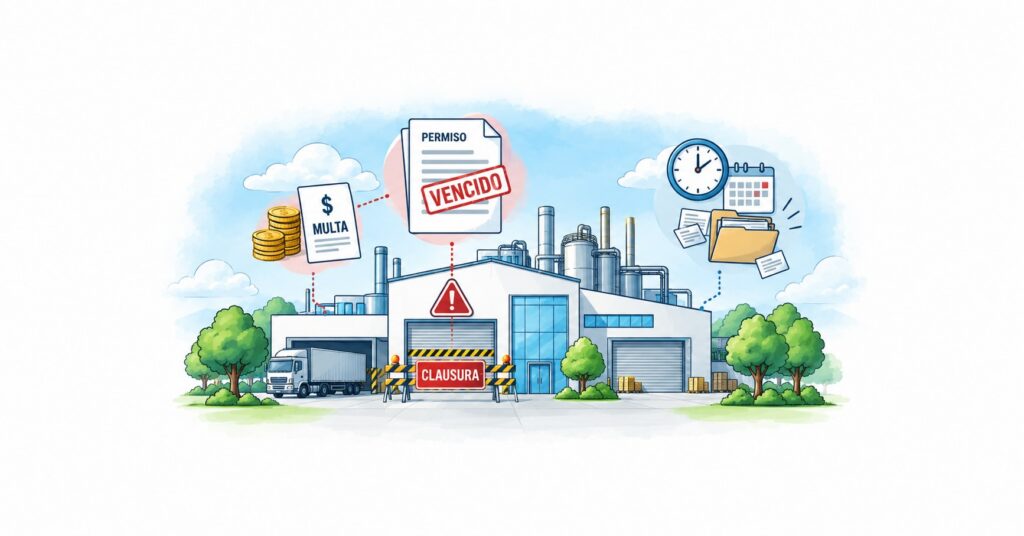
Critical point: EIA authorization conditions are not suggestions. They are enforceable legal obligations. Non-compliance triggers PROFEPA enforcement including closure, fines, and potential criminal liability. Many companies focus on obtaining authorization and then lose track of the conditions in force. This is one of the most common environmental compliance failures in Mexico.
The EIA Does Not End When You Get Approved
Obtaining authorization is the starting line for ongoing compliance. Conditions typically include:
Environmental monitoring programs: periodic air quality measurements, water discharge sampling, noise monitoring, soil quality testing, and biodiversity studies. Frequency ranges from monthly to annual. Results must be reported to SEMARNAT on schedule.
Implementation of mitigation measures: each measure proposed in your EIA and accepted by SEMARNAT must be implemented within the specified timelines.
Periodic reports: SEMARNAT may require compliance reports. This overlaps with but is separate from the Annual Operations Report (COA).
Change management: if operations change—new processes, expanded capacity, different materials, additional buildings—you may need to update your EIA or submit a new one.
The EIA in Context: Other SEMARNAT Permits
The EIA is the entry authorization, but most facilities also need:
Single Environmental License (LAU): the comprehensive air emissions license for facilities under federal jurisdiction.
Hazardous Waste Generator Registration (NOM-052): facilities that generate hazardous waste must register with SEMARNAT.
Annual Operations Report (COA): mandatory annual report with detailed data on emissions, water discharge, hazardous waste, energy consumption, and water use.
Water Discharge Permits: industrial facilities that discharge into federal water bodies need a permit from CONAGUA.
Where Companies Go Wrong
Filing at the wrong jurisdiction level. Submitting a state EIA for an activity requiring federal authorization. The authorization may be invalidated.
Underestimating the baseline study. A weak baseline leads to incomplete impact identification, insufficient mitigation measures, and requests for additional information from SEMARNAT—adding months to the timeline.
Losing track of authorization conditions. The most common ongoing failure. Companies obtain the EIA, file it away, and forget the specific conditions SEMARNAT imposed.
Not updating the EIA for operational changes. Expanding a plant, adding production lines, changing raw materials, or constructing additional structures may trigger a new EIA.
Treating the COA as optional. The annual report is mandatory. Late or missing submissions are one of the most common SEMARNAT violations.
From Environmental Authorization to Environmental Control
The environmental compliance challenge for industrial operations in Mexico is not obtaining the EIA—it is managing everything that comes after. EIA conditions, LAU emission licenses, hazardous waste manifests, annual COA reports, water discharge monitoring, and change management—all need to be tracked, documented, and continuously evidenced.
Most environmental compliance failures in Mexico are not knowledge failures. They are tracking failures. The company knows the rules. It simply cannot maintain visibility over every obligation, every site, and every renewal cycle at the same time.
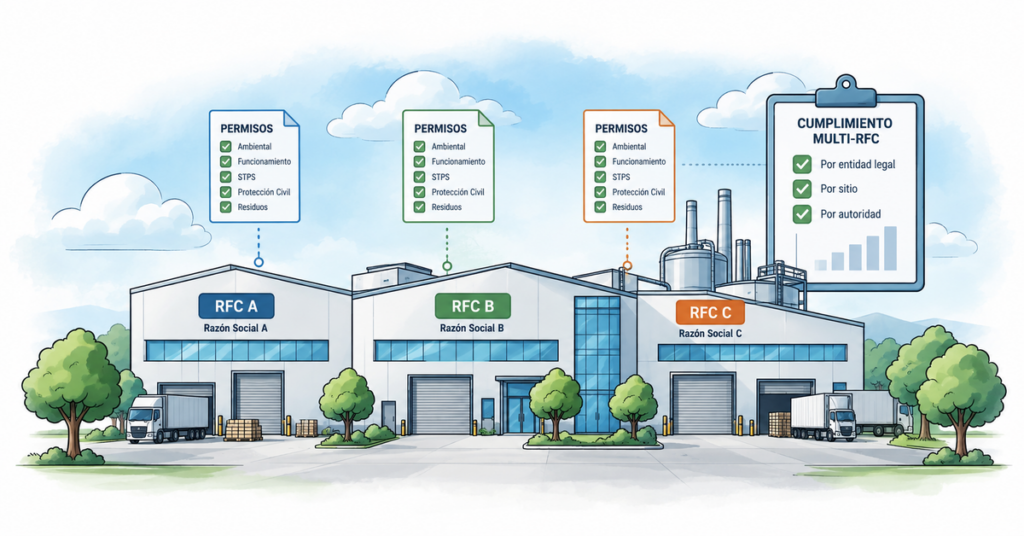
NAPSsoft EHS structures SEMARNAT obligations as trackable compliance categories alongside STPS safety NOMs and other regulatory requirements. Each environmental permit has an assigned owner, a schedule, linked evidence, and traffic-light status. When PROFEPA arrives, the evidence is one click away.
Everything About EHS Software for Mexico

Take your compliance to the next level