



Internal Civil Protection Program (PIPC): The Multi-State Obligation
The Internal Civil Protection Program is a key regulatory challenge in Mexico for a structural reason: although the framework is federal, the procedures and renewals are strictly local. What the authority accepts in Querétaro may not be enough in Tijuana, and Mexico City's formats don't apply in Nuevo León.
Key Principles of the PIPC
- Obligation per property: the basis is found in articles 39 and 40 of the General Civil Protection Law. Each plant or facility requires its own individualized file, adapted to the risks of its location. An operation with ten plants needs ten programs.
- Structure in three subprograms: Prevention, with the analysis of internal and external risks, signage, firefighting equipment, and trained brigades. Response, with emergency and evacuation protocols. And Recovery, with the actions for operational continuity after a contingency.
- Accredited third parties: medium- and high-risk properties must have the backing of a consultant with a valid state registration. That third party's letter of co-responsibility is part of the file in most procedures.
The Internal Civil Protection Unit
The law requires creating an organizational structure called the Internal Civil Protection Unit, responsible for drafting, updating, operating, and overseeing the program. Its content is detailed in the LGPC Regulations, articles 74 to 77. The typical file includes general property data, training certificates for brigade members in first aid, firefighting, evacuation, and search and rescue, documented evidence of drills, and, where applicable, the civil liability policy.
The multi-state challenge: renewals, formats, and different authorities
This is where the PIPC becomes a real operational problem for multi-plant operations. Revalidation periods vary by state, and in several jurisdictions—Mexico City among them—the update is annual. The registry of accredited third parties is state-level, so a consultant valid in one state may not be registered in another. Formats change between states and even between municipalities. And sanctions are also local, with fines and even temporary closure of the property.
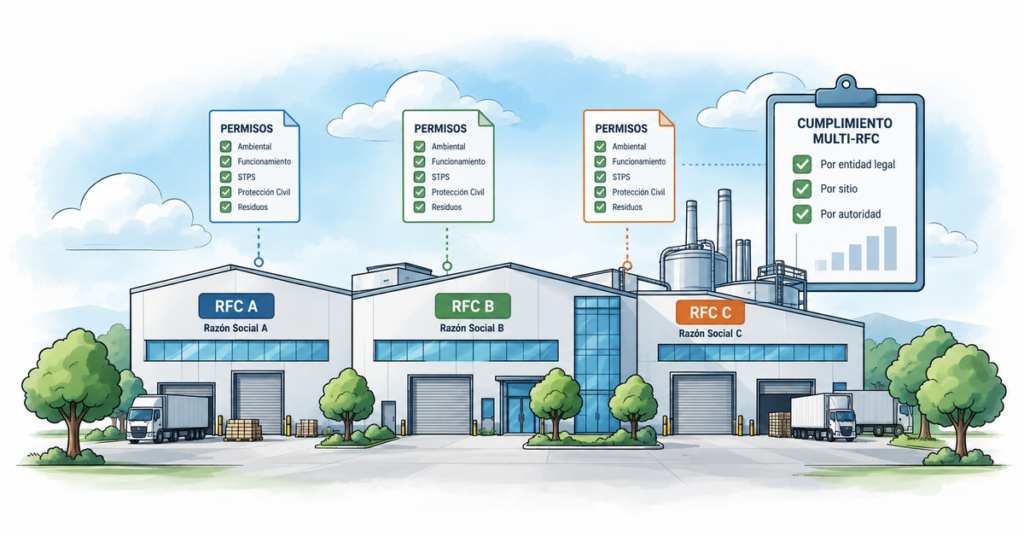
For a coordinator with five or ten plants, that means five or ten different procedures, with different calendars, before different authorities. Without standardized control of validity dates, responsible parties, and site-by-site evidence, follow-up becomes a permanent administrative burden and the risk of an expired renewal grows with each new site.
The PIPC intersects with everything else
The program doesn’t exist in isolation. It intersects with NOM-002-STPS-2010 on fire prevention and firefighting and with NOM-026-STPS-2008 on signage, and it is often a requirement for civil protection approval or the municipal operating license. The same drill or the same brigade certificate can serve as evidence for more than one obligation. Managing that evidence centrally avoids duplicating work and ensures consistency before any authority.
Standardizing the management of Civil Protection programs across multiple sites in a single platform turns fragmentation into a manageable process.
Sources consulted
- General Civil Protection Law, arts. 39 and 40: http://www.diputados.gob.mx/LeyesBiblio/pdf/LGPC.pdf
- Regulations of the General Civil Protection Law, arts. 74 to 77
- CNPC, official presentation on the Internal Civil Protection Program: https://www.gob.mx/cms/uploads/attachment/file/671450/TEMA_1_PROGRAMA_INTERNO_PROTECCION_CIVIL.pdf
- Guide for the Preparation and Updating of the PIPC, Civil Protection Baja California: http://www.proteccioncivilbc.gob.mx/Doctos/GuiaElaboActPIPC_V02.pdf
- SGIRPC CDMX, terms of reference and revalidation of the PIPC: https://www.proteccioncivil.cdmx.gob.mx/
- NOM-002-STPS-2010 and NOM-026-STPS-2008 (DOF)
Everything About EHS Software for Mexico


Take your compliance to the next level