



The Real Cost of an Expired Permit: Fines, Shutdowns, and What Doesn’t Show Up on the Invoice
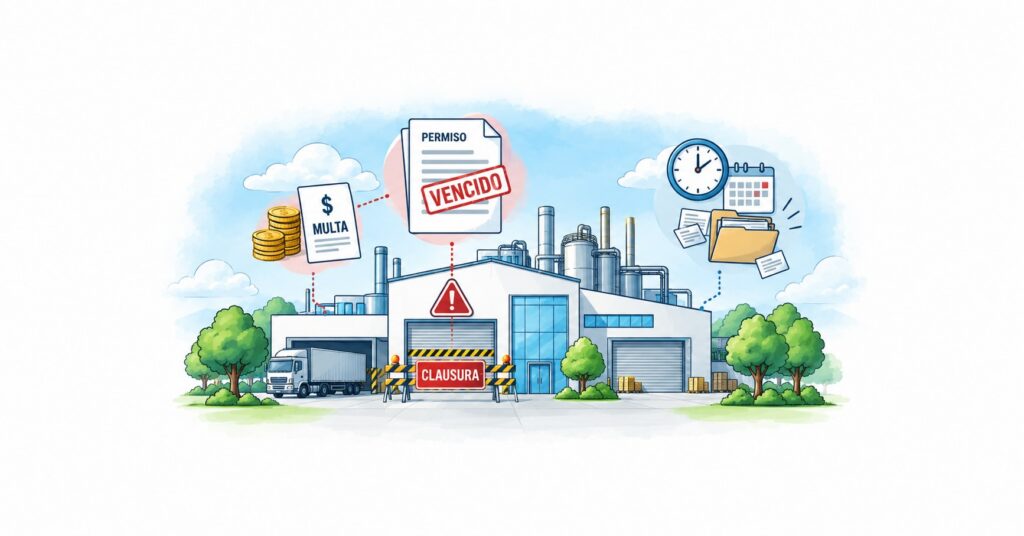
When people talk about the cost of an expired permit, the conversation usually starts and ends with the fine. That's a miscalculation. The fine is the visible part, and often the cheapest part of the problem. The real cost is made up of layers, and the most expensive ones almost never show up on a receipt.
The first layer: financial penalties
Fines in Mexico are generally calculated in UMA, the Unit of Measurement and Updating, whose value is updated every year. The ranges depend on the subject matter and the authority involved. In labor matters, Article 994 of the Federal Labor Law provides for fines of 250 to 5,000 times the UMA for violations of safety and health standards, per infraction. In environmental matters, Article 171 of the LGEEPA allows fines from 30 up to 50,000 times the UMA, in addition to other measures.
The multiplier matters: penalties can be applied per infraction detected and, in certain cases, per affected worker. An inspection that finds several non-compliances doesn't generate one fine — it generates a sum of fines.
The second layer: the shutdown of operations
Authorities hold powers that carry more weight than any fine. In labor matters, in the face of imminent danger to workers, the authority can restrict access or limit operations in risk areas. In environmental matters, the law provides for temporary or permanent closure, total or partial. And at the municipal level, operating without a valid operating license can lead to the suspension of the establishment's activities.
For a manufacturing plant, a day of shutdown is measured in undelivered production, payroll paid without operating, and customer penalties for missing schedule commitments. In operations that supply automakers or just-in-time supply chains, contractual penalties can far exceed any sanction from the authority.
The third layer: the silent costs
Beneath all of this lies a layer that's rarely accounted for. The team hours spent responding to the requirement, rebuilding files, and negotiating deadlines. The legal and consulting fees to regularize things urgently, which always cost more than doing the paperwork on time. The added scrutiny: a sanctioned plant lands on the authority's radar, and visits become more frequent. And the reputational cost with corporate clients who audit their suppliers and ask about compliance history.
Why it happens, even though nobody wants it to
It's almost never negligence. It's visibility. The permit expired because its date lived in a spreadsheet nobody opened in time, or in the inbox of someone who no longer works there, or because the renewal process takes four months and was started with six weeks to go. Renewing certain environmental permits requires months of lead time, and that information — the real processing timeline — is exactly what's never written down anywhere.
The cost of an expired permit is paid once, and it hurts. The cost of lacking visibility is paid every day, and it's invisible. Operations that centralize expiration dates, processing timelines, and owners don't eliminate regulatory risk, but they turn it into something manageable: they know what's expiring, when to start each renewal, and who's responsible for it. Seen from the standpoint of total cost, that difference pays for itself.
Sources consulted
- Federal Labor Law, Art. 994 (fines of 250 to 5,000 UMA for safety and health violations): https://www.diputados.gob.mx/LeyesBiblio/pdf/LFT.pdf
- General Law of Ecological Balance and Environmental Protection, Arts. 170 and 171 (safety measures and fines of 30 to 50,000 UMA): https://www.diputados.gob.mx/LeyesBiblio/pdf/LGEEPA.pdf
- INEGI, current UMA value: https://www.inegi.org.mx/temas/uma/
- RGITAS, immediate enforcement measures in the face of imminent danger (DOF 08/23/2022)
Everything About EHS Software for Mexico

Take your compliance to the next level